
Fulfillment
2026 Peak Season: Inside the warehouse
See how Pattern’s warehouses run peak, from inbound and pick and pack to sortation and full truckloads into Amazon, and why your stock should land early.
November 10, 2026

July 7, 2021

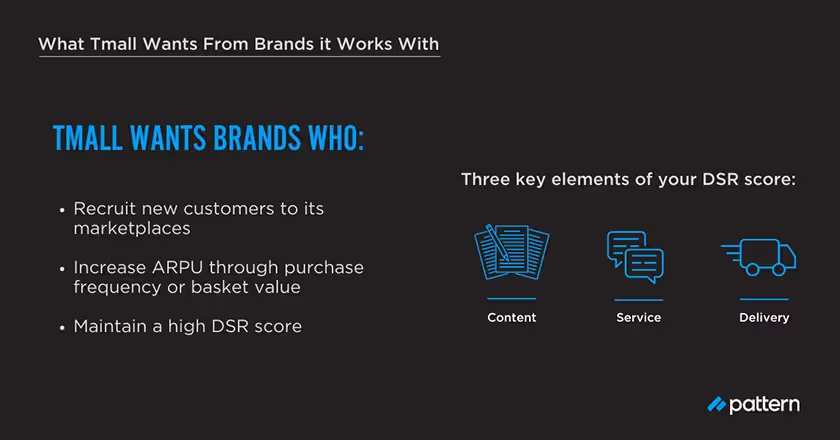
Boasting 779 million annual active consumers and circa 60% market share in China alone, Tmall acts as a first port of call when searching for products and product content. Tmall wants to work with merchants who bring in new customers and exposure for its platforms. It also only wants brands with a high customer feedback rating – called a DSR score - measured on content, service, and their delivery experience. In this blog we explain what a DSR score is, why it matters for brands selling on China’s largest marketplace and our tips on how to take a data-driven approach to Tmall trading.
The gulf between those brands who do well on the marketplace and those who don’t has widened in the past couple of years. Tmall has become much more selective about the brands it recruits to its domestic and cross-border platforms, and even whether it will renew a contract with a brand.
The DSR (Detailed Seller Rating) score can be found on your brand’s Tmall Flagship store and acts as a benchmark in line with the marketplace’s best-practice recommendations. Your brand’s DSR score is made up of three key elements of the shopping experience: the quality of your product content, logistics proposition and customer service levels. It is displayed publicly to shoppers to help them decide who to buy from.
The sheer volume of international brands available on the marketplace means having a high DSR score is crucial if you want to ensure that one-time purchasers of your brand are converted into repeat purchasers. In fact, Tmall will warn brands if it is not happy with their sales or DSR score; and if the poor DSR score is not quickly rectified Tmall stores can even be closed.
For Western brands to succeed in China, we always recommend taking a data-driven approach to Tmall trading. Data is also available to support brands’ strategic and tactical decision-making at every stage of the Tmall journey for a brand:
Just looking at your top-line sales or profit target isn’t enough to win on the marketplace. Likewise, having a partner that's just as invested as you in your Chinese ecommerce store and growth is important, but it's even more important that you choose wisely when going with a China ecommerce trade partner. Pattern are a Tmall 5* Trade Partner, and provide full-service support on everything from market entry strategy, Tmall Flagship Store set-up and the ongoing operation, marketing and trading of your Tmall store. We also act as a Trade Partner for JD.com, WeChat, Pinduoduo and Koala. For brands looking for a wider presence across Asia Pacific, we can support your launch on Lazada, Coupang, Shopee and Amazon.jp. Contact us now to discuss how we could support your Tmall sales, or other ecommerce or marketplace challenges that you face.
Latest blogs to check out.
Fulfillment
2026 Peak Season: Inside the warehouse
See how Pattern’s warehouses run peak, from inbound and pick and pack to sortation and full truckloads into Amazon, and why your stock should land early.
November 10, 2026

AI
What is agentic shopping, and what does it mean for brands?
Agentic shopping is when AI agents search, compare and buy for shoppers. See how it works, where it's live today and what it means for brands.
November 6, 2026

Fulfillment
Amazon RDCs: what triggers RDC routing and what to do about it
Amazon can hold inbound stock at an RDC before it reaches an FC. See the two triggers we’re seeing, what reserved status means and how to plan shipments.
November 3, 2026